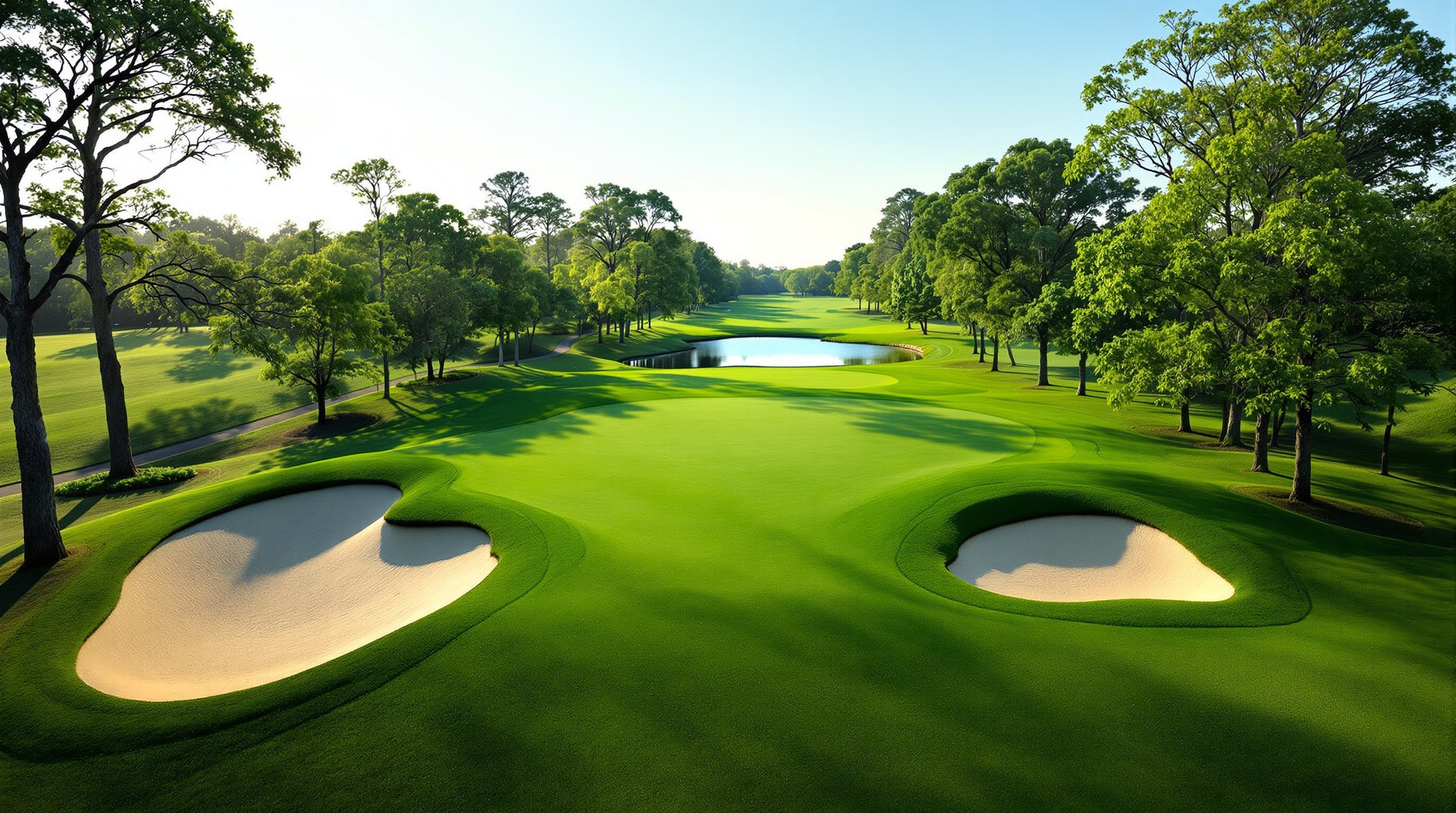
To understand why the lakeside course at Sawmill Creek plays the way it does, it helps to understand the man who routed it. Tom Fazio is one of the most decorated golf-course architects of the modern era — named Golf Digest’s best modern-day designer for years running, with more courses on America’s “greatest” lists than any living architect. Sawmill Creek, opened in 1974, is an early work: only the fourth course Fazio designed on his own after years co-designing with his uncle George Fazio. Reading a Fazio hole is a skill, and it makes any of his courses more enjoyable to play.
Land first, then golf
The defining idea in Fazio’s work is a “harmonious transition from existing topographical conditions.” In plain terms: he routes with the land instead of bulldozing against it. At Sawmill Creek that means fairways that ride the region’s rolling glacial terrain, greens set into natural high points, and a routing that uses the creek, the ponds and the edge of Lake Erie as found features rather than manufactured obstacles. You will rarely stand on a dead-flat lie here, and that is by design — the ground movement is part of the test.
Elevated tees and the reveal
Fazio loves an elevated tee, and Sawmill Creek has many. The practical benefit is a clear view of the hole in front of you: the trouble is visible, the target is framed, and the strategy is legible before you pull a club. Psychologically, that reveal from a raised tee is a big part of why his courses photograph so beautifully and feel welcoming even when they are difficult. Take a moment on each tee to actually read what the architect is showing you — the safe line and the aggressive line are almost always laid out in plain sight.
Bunkers as signposts
Perhaps the most recognizable Fazio signature is his bunkering: large, flashy, free-form sand shapes with irregular edges. They are hazards, yes, but they are also signposts. A Fazio bunker frequently sits where it does to guide your eye and your aim, not simply to swallow a ball. Learn to ask why a bunker is placed where it is — often it is defining the ideal angle into a green or warning you off a sucker line — and you will make smarter decisions off the tee.
Water for effect
Water at Sawmill Creek is used “for visual effect” as much as for defense, in Fazio’s own framing. Ponds mirror the sky, the creek threads the front nine, and the back nine opens toward the lake and marsh. The result is a course that feels dramatic without being unfair: the water usually frames a hole or tightens an approach rather than lurking invisibly to punish a good shot. For a resource on how design and turf care intersect, the USGA’s course-care library is a good primer.
Greens that reward the approach
Fazio greens tend to be generous in size but firmly defended by their surrounds — run-offs, elevation and bunkering that punish the miss more than the pin-seeking approach. The lesson for your round is simple: play to the fat of the green, respect the elevation, and take your medicine when you short-side yourself. A middle-of-the-green two-putt is a small victory on a well-defended Fazio surface.
Why it matters on the day
You do not need an architecture degree to enjoy Sawmill Creek, but a little fluency in Fazio’s vocabulary — elevated tees that reveal, bunkers that point, water that frames, greens that reward the sensible approach — turns a pretty walk into an engaging strategic puzzle. Pair this with our lakeside playing tips and read up on the course itself before you go. For more on Fazio’s body of work, his firm’s site at Fazio Design is the definitive source.